Dark Academia Living Room Ideas: 14 Moody Looks for 2026
There is a particular hour — usually around dusk, usually raining — when a dark academia living room stops being a room and becomes a scene from a novel you half remember. The lamp pools its light on the chair arm, the books on the shelf lean the way books lean when people actually read them, and everything smells faintly of paper and candlewax. That is the whole point: not a showroom, but a lived-in library you get to come home to.
I have spent years slowly nudging my own living room in this direction, one thrifted candlestick and one second-hand bookshelf at a time. The good news is that 2026 is being unusually kind to this look: deep oxblood, forest green, and dark plum are all over interior trends, moody layered lighting is everywhere, and vintage furniture has never been easier to find second-hand. Below are fourteen ideas, tested in real rooms, organized from the big structural choices down to the small details that make a room feel scholarly instead of merely dark.
Dark Academia Living Room Foundations: Walls, Light, and Color
1. Commit to a dark, saturated wall color. This is the single highest-impact move you can make. A deep forest green, charcoal, or oxblood wall behind your sofa changes the physics of the room — suddenly the lamplight has something to glow against. If painting four walls feels too bold, paint one: the wall behind the bookshelves or the fireplace. Everything you hang or place against it will look richer for it.
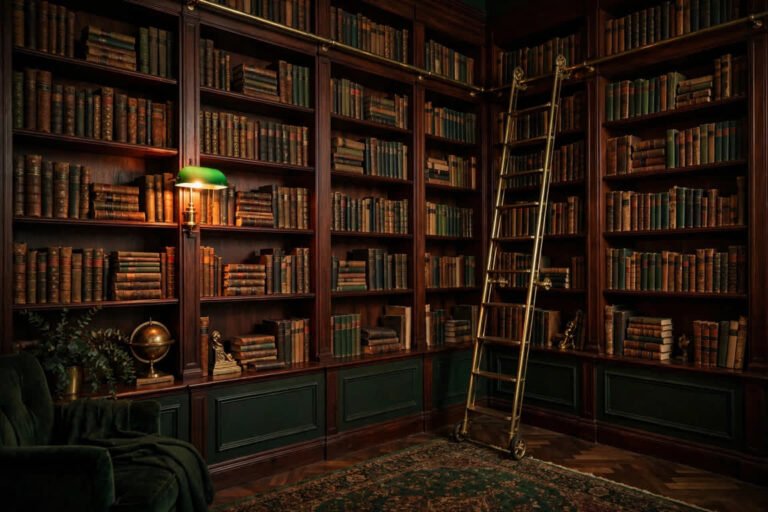
2. Build a floor-to-ceiling bookshelf wall. It does not have to be bespoke carpentry — tall second-hand bookcases lined up wall-to-wall, painted to match the wall color, read as built-in. Fill them with books you have actually read (the leaning, the battered spines are the aesthetic), mixed with a few objects: a brass globe, a framed sketch, a stack of art books on their sides.
3. Swap every bulb for warm amber. If you do exactly one cheap thing from this list, do this. Replace cold white bulbs with warm ones at 2700K or lower, and suddenly your ceiling light stops feeling like an office and starts feeling like a Victorian study. It costs less than a paperback and changes the room more than any single piece of furniture. Table and floor lamps only — overhead lighting is the enemy of mood.
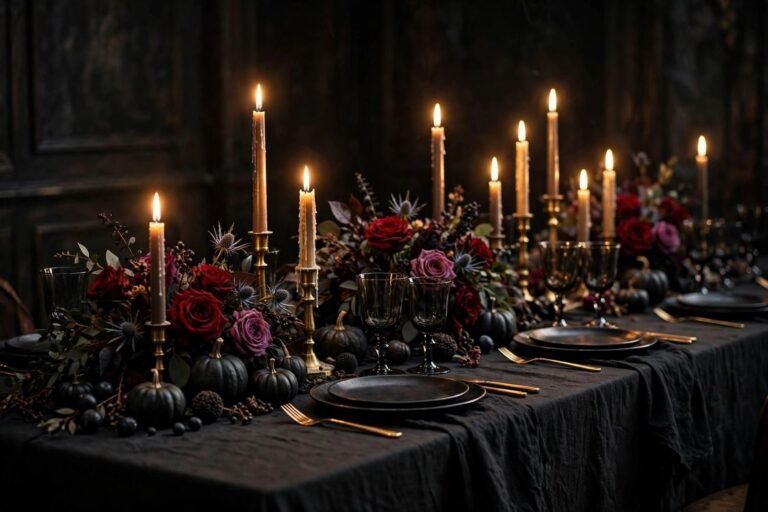
4. Collect brass candlesticks, mismatched and thrifted. Thrift stores are full of brass candlesticks for next to nothing. Buy five in different heights, group them on a tray, and light them every evening. Real flame beats every LED “ambience” setting ever invented.
5. Hang an oil-painting gallery wall. Dark landscapes, antique portraits, gilt frames with ornate corners — the more museum-after-hours, the better. Thrift shops and flea markets are full of exactly these. A gallery wall above the fireplace or the sofa gives the room its intellectual gravity, and it photographs beautifully in candlelight.
Dark Academia Living Room Furniture: The Statement Pieces
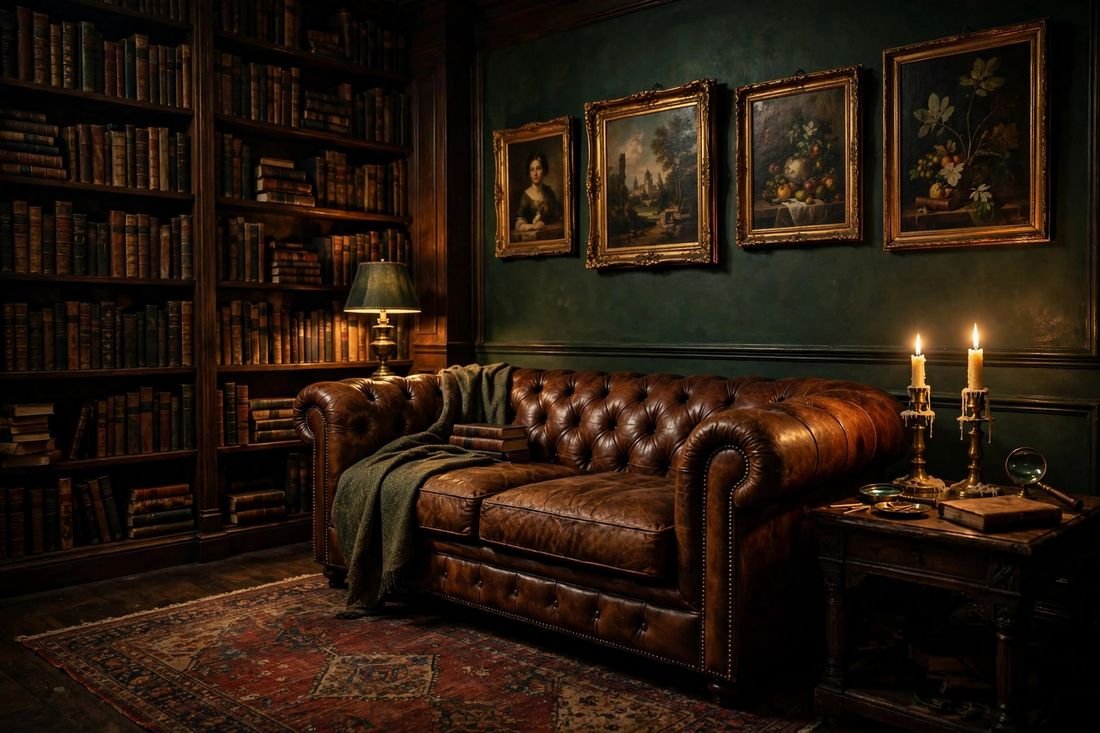
6. Anchor the room with a Chesterfield sofa. The low back, the rolled arms, the deep button tufting — nothing says dark academia faster than a Chesterfield. A cognac or oxblood leather one is the classic; a dark green velvet one is the 2026 answer. Second-hand leather Chesterfields soften and crease in ways that only make them better; do not be afraid of a worn one.
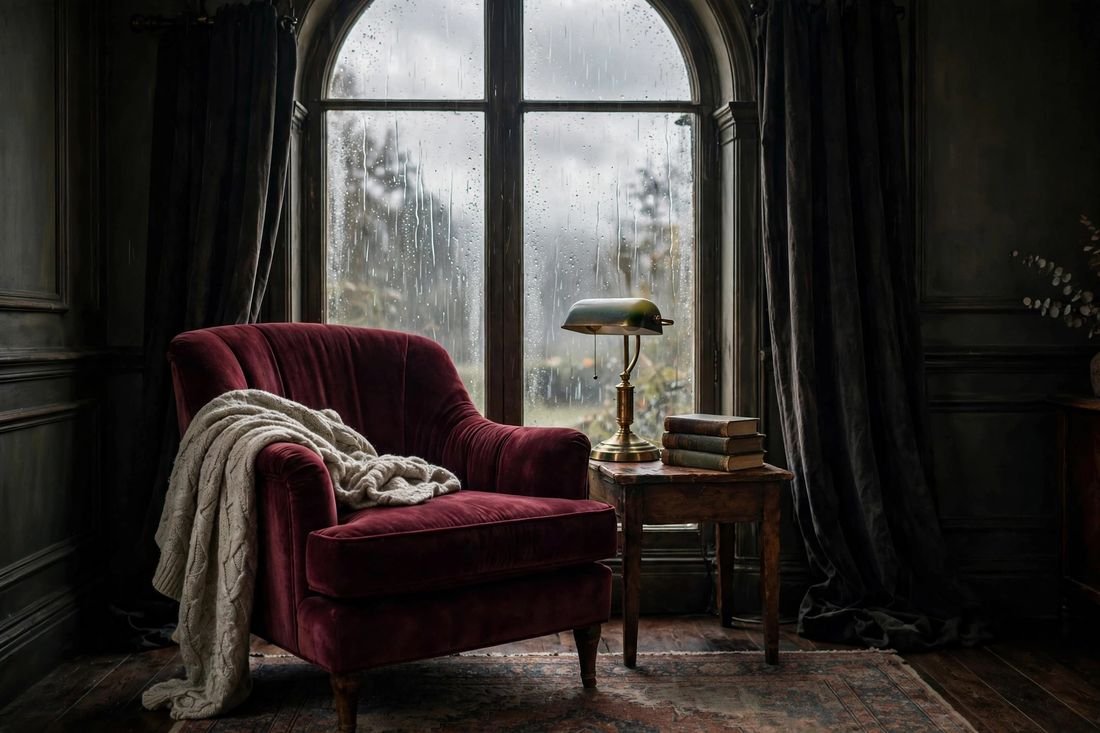
7. Make a velvet armchair reading corner. Every dark academia living room needs one chair that exists for a single purpose: disappearing into a novel. A wingback in oxblood, forest green, or midnight navy velvet, angled toward a floor lamp or a window, with a side table for tea and a knit throw folded over the arm. Mine sits by the window; on rainy evenings it is the best seat in the house.
8. Roll out a Persian or Turkish rug. A worn, patterned rug keeps a dark room from feeling flat — the pattern gives the eye somewhere to wander. Vintage-style rugs with a faded look are everywhere, and genuine second-hand ones surface at estate sales constantly. Size up; the front legs of the sofa should always sit on it.
9. Bring in a globe bar cart. Roll a brass or dark-wood bar cart into the corner and treat it like a prop from a detective novel: a decanter, a few cut-glass tumblers, a stack of leather-bound books underneath. Ours holds a teapot most days, and honestly the teapot works just as well.
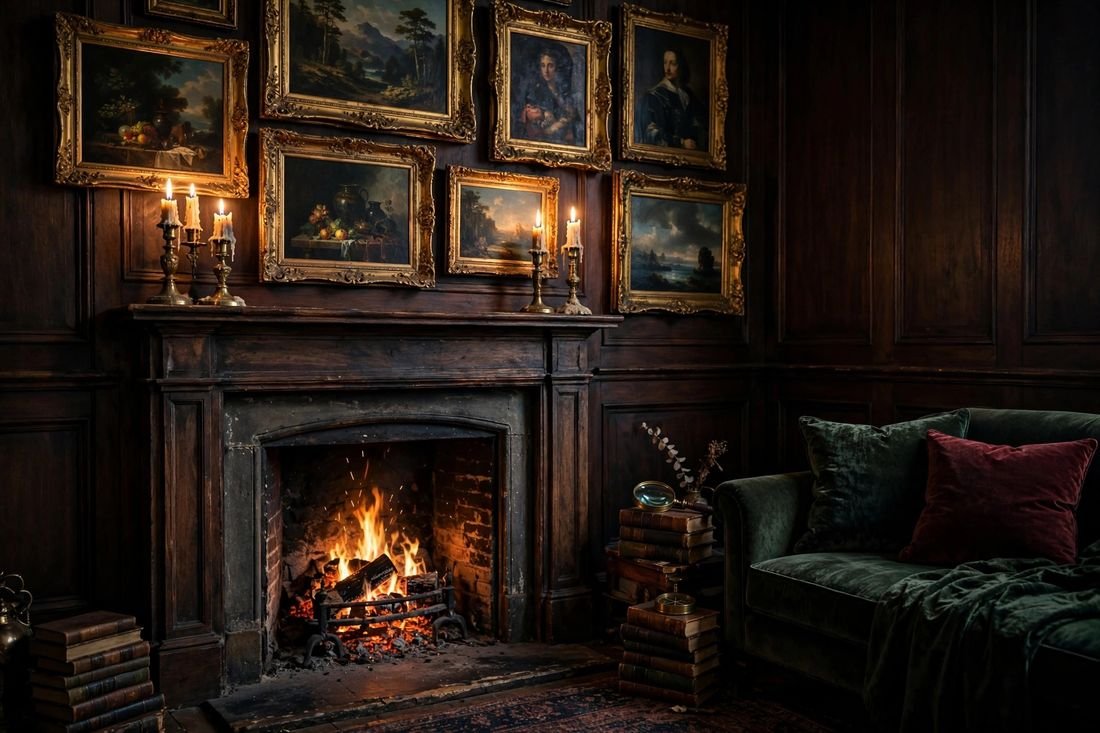
10. Style the fireplace — or fake one. A working fireplace is the soul of a dark academia living room: candlesticks along the mantel, a stack of books styled beside it, a gilt mirror or gallery wall above. No chimney? An electric log insert in a vintage mantel, or a mantel shelf with a tight row of pillar candles in the firebox, gives you ninety percent of the effect for a fraction of the cost.
The Details That Make a Dark Academia Living Room Feel Alive
11. Layer heavy drapes in dark fabrics. Velvet or thick linen curtains in deep tones — forest, oxblood, charcoal — frame a window like a painting and make the room feel sealed off from the ordinary world. Let them puddle slightly on the floor. Behind them, a rainy window does the rest of the work for you.
12. Display a leaning stack of art books. A tall stack of oversized art and architecture books on the coffee table, styled slightly off-center with a candle on top, gives you the professor’s-study energy without needing a library ladder.
13. Add deep green foliage in vintage vessels. Ferns, trailing ivy, or a snake plant in a brass pot or a chipped ceramic urn keep the room alive and stop it from feeling like a stage set. One or two plants is plenty — dark academia is moody, not a greenhouse.
14. Keep a writing desk (or a tray) by the window. The last detail, and the one that makes the room feel inhabited: somewhere to write. A small antique desk with a fountain pen and a stack of correspondence is the dream version. The apartment version is a wooden tray with a notebook, letters, and sealing wax kept on the reading chair’s side table — an invitation to yourself to sit down and write something. For seasonal inspiration, our fall dark academia decor roundup leans into this ritual side of the aesthetic.
How to Start a Dark Academia Living Room on a Budget
You do not need a manor house budget — mine is a rented apartment and a thrift habit. The honest priority order, if money is tight:
Lighting first. Warm bulbs and a tray of thrifted candlesticks cost almost nothing and transform the room overnight. Mood is ninety percent lighting.
Paint second. One wall of deep green or charcoal is a weekend project and a couple of paint cans. It makes every piece of furniture you already own look more expensive.
Textiles third. A second-hand Persian-style rug, heavy dark curtains, and two or three velvet cushion covers layer in the warmth. These are the items that make the room feel finished.
Furniture last. The Chesterfield, the wingback chair, the bar cart — buy these slowly, second-hand, one at a time. Dark academia rewards patina; the worn piece is the right piece. The aesthetic is built to be collected, not purchased in a day. If you want to push the mood further, our gothic Halloween decor ideas pair surprisingly well with a candlelit dark academia living room year-round.
Dark Academia Living Room FAQ
Can a dark academia living room work in a small apartment?
Yes — arguably better than in a big one. Small rooms take to dark walls and layered light beautifully: one lamp and three candles can light the whole space. Keep the palette tight (two dark tones max), use mirrors strategically, and let the bookshelf wall do the talking.
What colors define a dark academia living room in 2026?
The 2026 palette centers on deep forest green, oxblood, dark plum, charcoal, and warm browns, with brass and gilt accents for warmth. Avoid pure black walls (they flatten the light); rich, saturated tones with visible undertones live much better.
How is a dark academia living room different from gothic decor?
Dark academia leans scholarly and literary — libraries, letter-writing, old universities — while gothic decor leans toward the macabre and dramatic. The two overlap beautifully (candlelight is candlelight), but dark academia stays warmer and more lived-in.
Do I need real candles, or will LED work?
Real tapers and pillar candles win on atmosphere every time — the flicker is the point. If real flame is not an option, high-quality LED tapers at a warm color temperature are a fine stand-in for background glow, but keep them behind frosted glass so the fake filament does not give the game away.